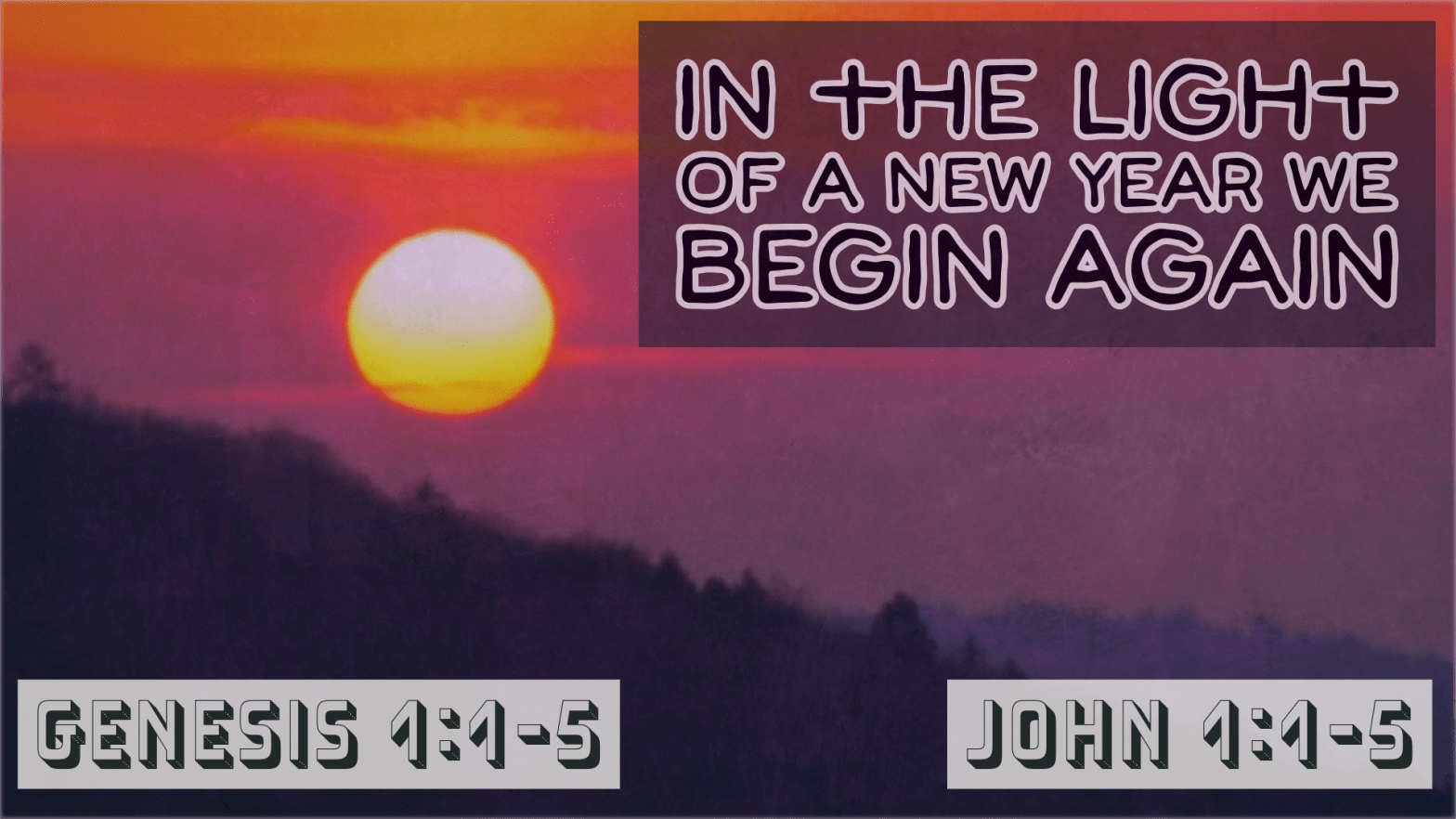
1 In the beginning, God created the heavens and the earth. 2 The earth was without form and void, and darkness was over the face of the deep. And the Spirit of God was hovering over the face of the waters. 3 And God said, “Let there be light,” and there was light. 4 And God saw that the light was good. And God separated the light from the darkness. 5 God called the light Day, and the darkness he called Night. And there was evening and there was morning, the first day.
The Holy Bible: English Standard Version (Wheaton, IL: Crossway Bibles, 2025), Ge 1:1–5.
1 In the beginning was the Word, and the Word was with God, and the Word was God. 2 He was in the beginning with God. 3 All things were made through him, and without him was not any thing made that was made. 4 In him was life, and the life was the light of men. 5 The light shines in the darkness, and the darkness has not overcome it.
The Holy Bible: English Standard Version (Wheaton, IL: Crossway Bibles, 2025), Jn 1:1–5.
At the beginning of a new year, the image that comes to mind is that of a blank slate: crisp planners, empty calendars, and clean pages that have yet to be marked. January feels fresh, full of possibilities, and the shelves are lined with tools for organizing and reinventing life. Many people head to the gym with renewed determination, crowding the space for the first couple of weeks as they try to improve themselves. That same impulse toward new beginnings should exist spiritually as well, stirring a hunger to pick up Scripture with a fresh commitment and to start again with God. Beneath that desire lies a deeper awareness that something inside is not right, that there is hurt, groaning, and a genuine need for change.
This need for a true new beginning is reflected in the opening of Genesis, where the earth is described as without form and void, with darkness over the face of the deep and the Spirit of God hovering over the waters. The picture is one of confusion, emptiness, and shapelessness—a world in chaos. Into that chaos, God does not struggle or force anything; God simply speaks. With the words “Let there be light,” light appears, order begins, and God separates light from darkness and calls it good. Even today, the phrase “Let there be light” echoes in places like the University of California’s motto, expressing a commitment to bringing illumination and understanding into confusion. This is how God works: by the power of a spoken word that brings order, meaning, and goodness where there was once only disorder.
The prologue of the Gospel of John picks up this same theme of beginnings, declaring that in the beginning was the Word, and the Word was with God, and the Word was God. John intentionally echoes Genesis to show that the arrival of Jesus is a new creation event, an act of re‑creation in a dark world. By using the Greek term logos, John speaks both to the Hebrew story of creation by God’s word and to the Greek understanding of logos as the ordering principle of the universe. Logos is no mere concept; it is a person, Jesus Christ, through whom all things were made, in whom is life, and whose life is the light of humanity. The light shines in the darkness, and the darkness cannot overcome it, even when that darkness takes the form of rejection, suffering, and the cross.
Because of this, the hope for a new year is not found in a reset button that erases the past, but in God’s ongoing work of re‑creation. No one can truly wipe away their history or pretend their failures never happened, and Scripture does not begin with a world that is already good, but with one that is disordered and chaotic. God speaks into that chaos and only then declares it good, just as Christ confronts sin rather than skipping over it. Personal chaos, stress, anxiety, fear, broken relationships, does not vanish the moment someone turns to Christ; those patterns continue to threaten and return. The call is to remember where those patterns came from, to understand the past rather than ignore it, and to let God’s word keep speaking order and light into the places where darkness tries to reemerge.
In a world where each morning’s headlines reveal new sites of chaos and brokenness, God still says, “Let there be light,” and invites people to be that light in the new year. This invitation is not about forcing change or overpowering others, but about quietly and consistently reflecting the light of Christ through everyday life. The world does not need more clever religious slogans or symbols to identify Christians; it needs men and women whose kindness, consideration, love, and integrity make the presence of Christ visible. Each sunrise and sunset becomes a reminder to “do it again,” to begin again in being light in the darkness. To step into this year, then, is to accept the opportunity to live outwardly what God has begun inwardly, letting the eternal light placed within shine so that others can see and know there is a God who still brings order out of chaos and invites everyone to begin again.
 Horizon Community Church